Light your steps
It lights the ground nearby, reveals mechanisms and shows dangers before they arrive. It doesn't attack.
AN ADVENTURE BY COPAL GAMES
A supernatural ball is your weapon and your only light.
Descend through the houses of Xibalbá and outwit their Lords.
In development for PC, Android and iOS · Password-protected web test
Every night, a young ballplayer hears a ball striking stone beneath the village's abandoned court. One dawn he answers: he strikes once, and from below, someone strikes back.
The stone cracks and he falls into a cavern where dawn never comes. There he finds a black ball crossed by glowing cracks, with a living light pulsing inside. A voice tells him: “Anyone can play here. The hard part is leaving the court.”
The Lords of Xibalbá rule in darkness, and they want that light. They don't expect to beat you fairly: they expect you to accept their rules without question. To get out, you have to understand those rules and break them.
Xibalbá: The Last Light is original fiction inspired by the Xibalbá of the Popol Wuj, from the K'iche' Maya tradition. It does not retell the story: the player, the glowing ball, the guardians and the ending are the game's own invention.
The same ball attacks, lights the way and solves puzzles. Everything comes down to one question: where do you need the light right now? Beside you, on the enemy, or across the room?
It lights the ground nearby, reveals mechanisms and shows dangers before they arrive. It doesn't attack.
The light travels with it: it bounces off marked walls, hits enemies from behind and triggers distant mechanisms. Meanwhile, you're left in the half-dark.
It flies straight back to you. As in the Mesoamerican ballgame, the serve only gives light: what counts is striking it back with your hip at the right moment.
Every house and every guardian has a rule. Attacking head-on never works: you win when you understand the rule and break it with the room and the ball.
Dying isn't always losing. Before a Door of Camé, letting yourself be killed wakes you on the other side as a shadow: no body and no light, but jaguars and bats can neither see nor hear you.
It's never pitch black and it never hurts on its own. Every attack is telegraphed at any light level, and the ball always comes back when you call it.
The houses are those of the Popol Wuj. Each one makes you use the same ball differently, and each is watched by a guardian with its own trick. From the stands, a pair of Lords watches to see whether you accept their rules.
Further down waits the buried court, where Hun-Camé and Vucub-Camé preside over a match no one wins by their rules.
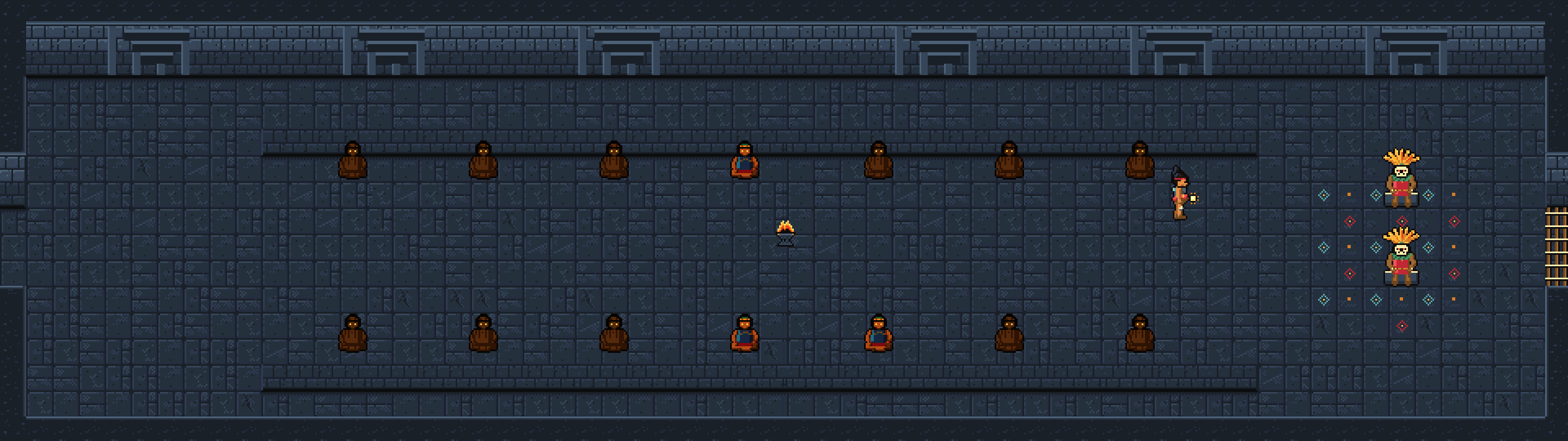
Actual screenshots from the game in development (in Spanish). Select an image to enlarge it.
Web version in development · Spanish and English · Keyboard and mouse, gamepad or touch
The private test is the full campaign in your browser: the fall, the rivers, the refuge, the six houses and the buried court. Access is private, with a username and password.
The test is closed. If Copal Games gave you a username and password, select “Play the private test”. To request access, write to support@copal.games.
An up-to-date browser on a computer, with keyboard and mouse or a gamepad. Phones and tablets get touch controls, still being tested. The first load downloads about 16 MB.
Yes. The game saves at rest points, inside the browser you use. If you clear the site's data or switch browsers, you start over.
The game is in Spanish and English; choose the language in Options. This site is available in four languages.
Yes: aim assist, a wider strike window, a hip-strike cue, reduced screen shake and flashes, high contrast in the half-dark, large text, adjustable brightness and remappable controls.
From the story come the six trial houses, the ballgame against the Lords and their names, cunning as the way to win, the wooden figures, the oven and the return after death. The player, the glowing ball, the guardians, the characters of the refuge and the ending are the game's own invention. Names and cultural texts are provisional and will be reviewed by a K'iche' cultural advisor.